How to annotate a book so you remember it
How to annotate a book: what to mark, a short symbol key, how to annotate without writing in the book, and how to turn notes into something you remember.
Contents8 sections
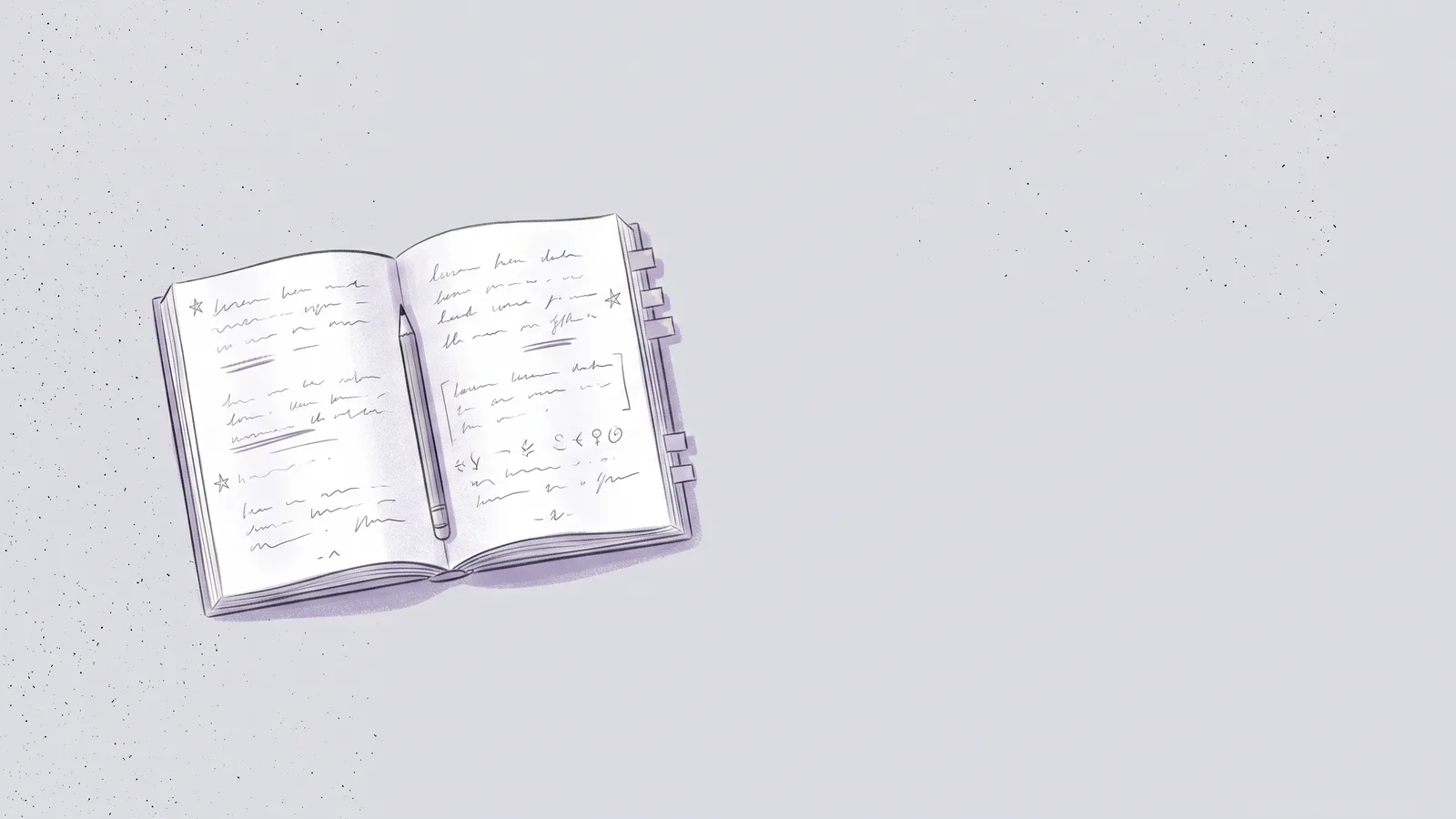
Here's how to annotate a book: read a section first, then go back and mark only what matters: underline the key lines, put a short note in the margin saying why each one matters, and write a two-line summary at the end of each chapter. Keep a small key of symbols so your marks mean the same thing in every book. If you can't write in the book, use sticky notes, or highlight and add notes on an e-reader.
That covers the marks. The step most annotation guides skip comes after the book: going back to your notes, so the ideas stay with you longer than a few weeks. This post covers both.
What to mark when you annotate a book
Mark the lines you would want to find again. For most books that means:
- the author's main claims, and the evidence behind them
- definitions and terms the rest of the book depends on
- passages that surprise you, or that you disagree with
- lines you'd like to quote
- places that connect to another part of the book, or to another book
In a novel, add characters (who they are when they first appear), turning points in the plot and themes that come back.
Mark less than you think you should. If half a page is highlighted, nothing on it stands out when you come back. Epic Reads puts it as "less is more" in its annotation guide, and Mortimer Adler, in his 1941 essay "How to Mark a Book", kept his strongest mark for the ten or twenty most important statements in a whole book.
A symbol key you can use in any book
A symbol key is a short list of marks that each mean one thing. You'll read your notes faster later, because a star always means the same thing. Adler's essay lists seven marks, and this simplified key is based on them:
| Mark | What it means |
|---|---|
| Underline | A main point or a strong statement |
| Vertical line in the margin | A passage too long to underline |
| Star in the margin | One of the most important ideas in the book (use rarely) |
| Circle | A key word or term |
| ? in the margin | Something you don't understand or don't agree with |
| Page number in the margin | This connects to that page |
| 1, 2, 3 in the margin | The steps of one argument |
Write your key on the inside front cover, so it's there when you reread. If you use colors, add them to the key too. One reader at The Diary of a Reader uses pink for heartfelt moments, blue for sad ones and orange for character development, and writes the meanings on the title page because they change from book to book.
How to annotate a book, step by step
- Read a section or a chapter before you mark anything. On a first pass everything looks important, and you'll underline too much.
- Go back and underline the few lines that carry the chapter. Use your symbol key in the margin.
- Next to each mark, write a few words on why you marked it: "main claim", "disagree, see p. 112", "use in my talk". A mark without a reason is hard to read a month later.
- At the end of the chapter, write a two-line summary in the space above the chapter heading or on the last page. Epic Reads suggests doing this right after you finish the chapter, while it's fresh.
- When you finish the book, use the blank pages at the back as an index. Adler listed the author's main points there, in order, with page numbers.
Here's one chapter followed through. You're reading Atomic Habits and reach the idea of habit stacking. You underline the formula, star it because it's the idea you'll use, and write "try with morning reading" in the margin. At the end of the chapter you write: "Tie a new habit to one you already do: after I pour my coffee, I read 10 pages." On the back page you add "habit stacking" with its page number. Two weeks later you open the book to the back page, find the line, and you're back at the idea in seconds.
How to annotate a book without writing in it
Library books, borrowed books and books you want to keep clean can still be annotated:
- Sticky notes. Write your note on a sticky note and put it on the page. Transparent sticky notes let you write over the text without covering it.
- Sticky tabs. Put a tab on the edge of a page you want to find again. You can give tab colors meanings, the same as a symbol key.
- A notebook. Write the page number and your note. This is also where chapter summaries go.
- A pencil. If you're allowed to mark the book but want to be able to undo it, a soft pencil erases cleanly.
On an e-reader the system is the same with different tools. A Kindle lets you highlight a passage and add a note to it, and saves both to a file called My Clippings.txt. The free Kindle highlights viewer sorts that file by book, so you can read every note you made in one place.
How to remember what you annotated
Annotating helps you read more carefully, but the notes on their own don't keep a book in your head. A 2013 review of ten study techniques led by John Dunlosky rated highlighting and underlining low for helping people learn. The two techniques rated highest were practice testing (answering questions from memory) and spacing practice out over time.
So write some of your margin notes as questions. Next to the habit stacking passage, write "What's the formula for habit stacking?" instead of "habit stacking". When you go back, cover the page, answer the question, then check. That's active recall, and it's the part of annotation that does the most for memory.
Then come back more than once. Look at your notes a day or two after you finish the book, again about a week later, and again a few weeks after that. Spreading reviews out like this is spaced repetition, and it slows down the forgetting that the forgetting curve describes. If you copy your best notes into a commonplace book, you can review notes from every book in one place.
Annotating the articles you read
I made Bundle for the articles you save to read later. You highlight as you read, and at the end of each article a Quick check asks you a few questions about it. You keep the good ones as cards, and Bundle brings each card back with spaced repetition, a little before you would forget it. So the question-writing step happens for you.
Bundle is on the App Store for iPhone, and you can try it free for 14 days.
Questions about annotating books
Is it okay to write in books?
In books you own, yes. Adler argued that marking a book is part of owning it fully. For library and borrowed books, use sticky notes or a notebook instead.
Should I annotate on the first read?
Read each section once before you mark it, then annotate on a second, quicker pass over the same section. You'll mark less and choose better.
What pens are best for annotating books?
Use a pen that doesn't bleed through thin paper, like a fine-point gel pen, or a pencil if you want to be able to erase. Highlighters that are too dark can show through on the other side of the page.
How do I annotate a fiction book?
Mark characters when they first appear, turning points in the plot, lines you'd quote and themes that repeat. A short list of the main characters on the inside cover helps with a large cast.
Quick check
Here are three questions on this article. Try to answer each one before you show the answer.
Why should you read a section before you mark it?
On a first pass everything looks important, so you underline too much. Reading the section first lets you mark only the lines that carry it.
What did Mortimer Adler use the blank pages at the back of a book for?
A personal index: the author's main points in the order they appear, with page numbers.
What change to your margin notes helps you remember the book?
Write some of them as questions, then answer the questions from memory when you come back, spaced out over days and weeks.
Get a Quick check after everything you read
Bundle asks you a few questions like these after every article you save, and keeps the answers you want as cards.

Sources
- Adler, M. J. (1941). How to Mark a Book. The Saturday Review of Literature, July 6, 1941.
- Epic Reads. How to annotate your books to the fullest.
- The Diary of a Reader. How to guide for annotating books like a pro.
- Dunlosky, J. and others (2013). Improving students' learning with effective learning techniques. Psychological Science in the Public Interest. Summary: Association for Psychological Science.
Keep reading

Read-it-later apps: what they do and which one to use in 2026
What a read-it-later app is, how it differs from bookmarks and your browser's reading list, the best read-it-later app for each kind of reader in 2026, and how to read what you save.

The best Pocket alternatives in 2026, compared
Pocket shut down in July 2025. Here are the best Pocket alternatives in 2026, with prices, platforms, who each one suits, and how to bring your Pocket export with you.
Safari Reading List: how to use it on iPhone, iPad and Mac
How to save pages, find your list, read offline and delete items in Safari Reading List on iOS 27 and macOS 27, and what it can't do.